Leads: a client-search pipeline run by agents
A chain of 12 agents for a client-search team: tips and drafts for staff, routine decisions sometimes made by the agents. Key decisions and sending stay with people.
Live since 29 October 2026
In numbers
- 100 leadsin the first batch for the sales team
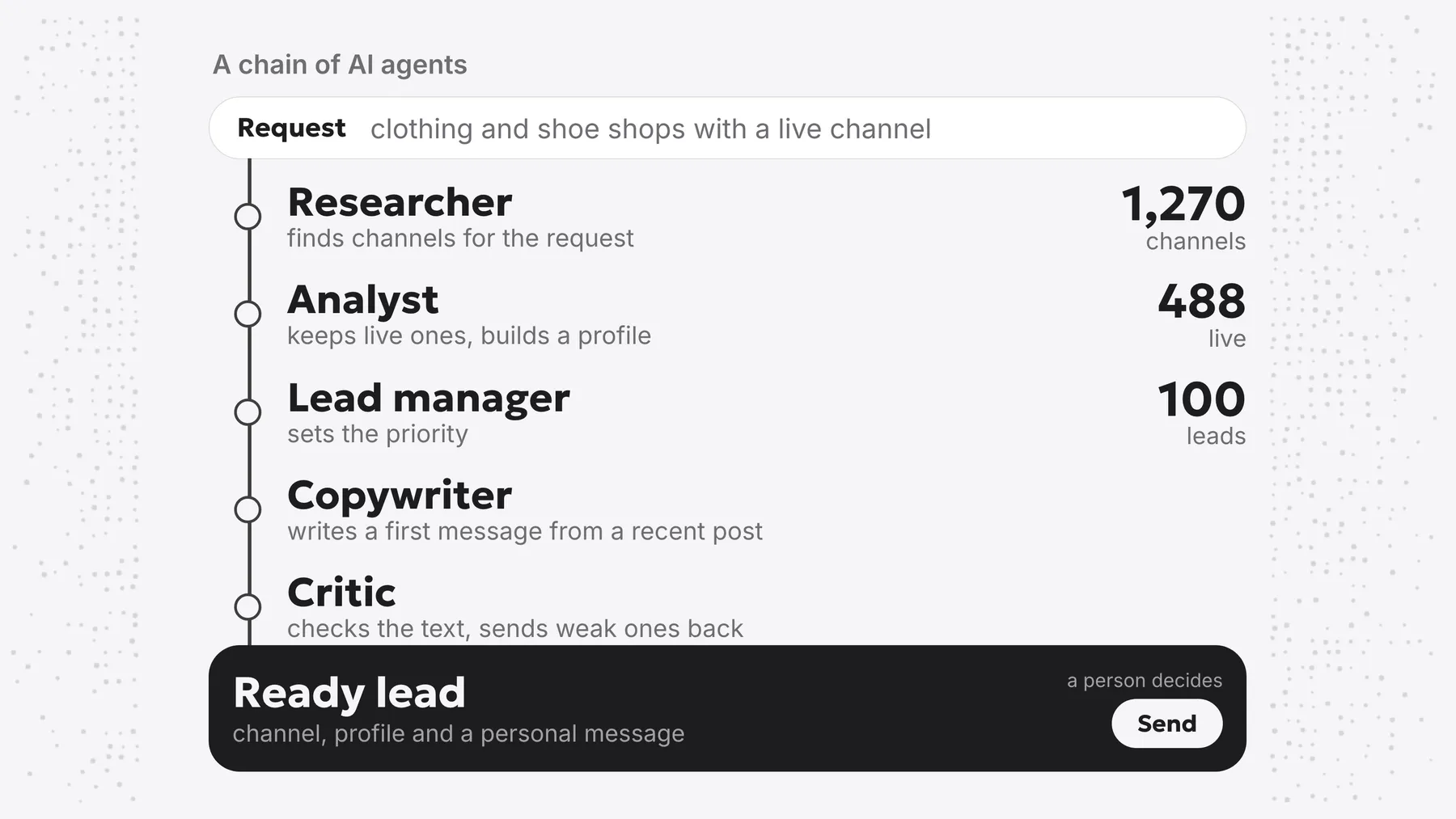
- About 1,270channels checked, 488 turned out to be alive
- A human decidesagents prepare drafts, an employee sends
Task
I was approached for a well-thought-out chain of agents that together give the staff of a client-search team extra advice, and sometimes make routine decisions themselves. Key decisions and sending stay with the staff: the agents help people as much as they can, but do not replace them.
Clients for bots and automation have to be found where they sell: in the open Telegram channels of shops, showrooms, resellers and wholesalers. By hand that is thousands of channels. What is needed is a pipeline that finds live channels, filters out dead and unsuitable ones, scores each by clear rules and prepares a personal first message based on a recent post. Only open data is used.
Solution
A factory with five belts. Between the belts are warehouses with the funnel counts, on the belts are agent and script machines, and two belts have quality control with a reject chute. The diagram is further down the page; here is what rides on each belt, in order.
- Belt 1, collection. Raw material comes in: open channel catalogues and search, 54 queries across three segments (shops and showrooms, wholesale and markets, resellers). The machine is a collector plus a snowball that pulls mentions of other channels out of posts. Output: warehouse A, 1,270 channels.
- Belt 2, liveness. Control at the entrance: 300 to 60,000 subscribers, clothing and footwear, geography. Rejects go to the reject chute but are never deleted: the tier is lowered and the reason recorded. The machine reads the channel’s public page: a post within 7 days, 3-4 posts in two weeks, 8 signs that orders are taken by hand. Output: warehouse B, 488 live channels.
- Belt 3, profile. Agent machines, the analyst and the lead manager: a channel profile by written rules and five priority tiers, from “write right now” to “not yet”. Output: warehouse C, 210 channels reviewed by hand, 100 leads in the first hundred.
- Belt 4, messages. The copywriter machine assembles a message from six parts: greeting, an observation from a recent dated post, a pain stated as an assumption, a solution and one benefit, a line about experience, one easy question. 350-650 characters, no prices, deadlines, pressure or made-up features; six variants of every part so that no phrase repeats in more than 20 % of messages. Control at the exit: an 8-point self-check, 14 table format checks, an independent sales critic. Rejects go back onto the belt: rewrite. Output: warehouse D, messages ready to send.
- Belt 5, sending. The human gate: an employee’s button in Shtab, no more than 20 first messages a day, one every 3 minutes, a freshness check of the hook before the click. Replied: a client card, the employee takes over, the assistant suggests replies “as me” from the sales cheat sheet. Silent: a follow-up after 3 days, no more than two, then the archive for 30 days.
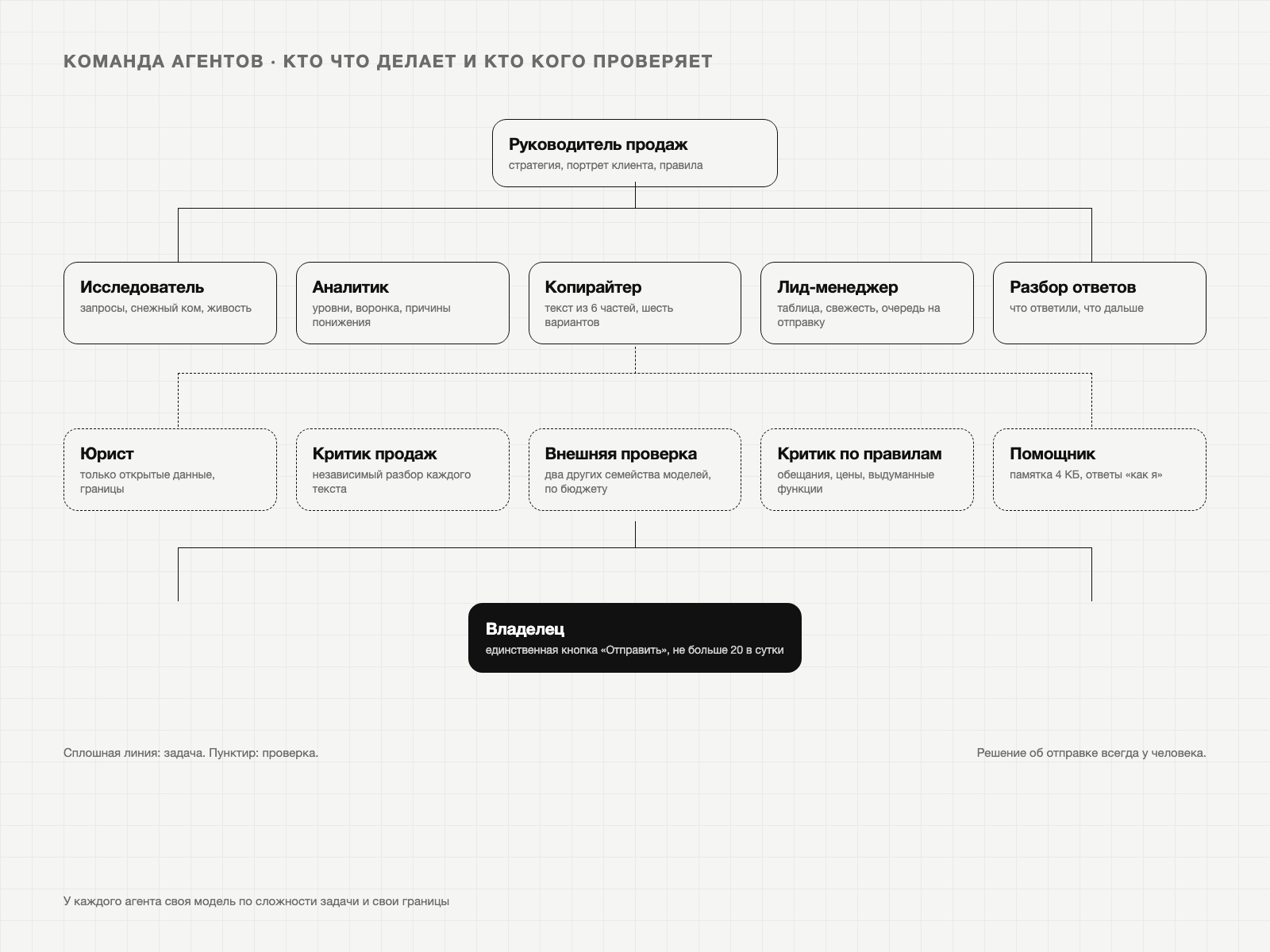
- The machine crew. 12 agents: head of sales, analyst, lawyer, researcher, copywriter, lead manager, reply triage, assistant, two critics and an external review team. Each has its own model by task complexity and its own boundaries.
- Learning by rules. Every remark from an employee or a critic becomes a check for all messages, so one mistake is not repeated.
What waits for what
- A message waits for liveness and freshness. It is written only for a channel from warehouse B and only from a post within 7 days; if the post goes stale before sending, the message returns to belt 4.
- Sending waits for three things at once: the human’s button, a free slot in the daily quota of 20 and a passed freshness check. If any of the three is missing, the message stays in warehouse D.
- A follow-up waits for 3 days of silence after the last message; there is never a third follow-up, and a new attempt with the same channel comes no sooner than 30 days later.
- A reply stops the follow-up belt: the lead becomes a client, the series goes to the log, the employee answers from there.
- Sending via the server waits for a live bridge: if the personal Telegram bridge on the server is off, Shtab sends by itself, with the same limit of 20.
- A rule waits for a remark: every remark from an employee or a critic becomes a check for all messages on belt 4.
Result
A complete chain was built: search, liveness check, channel profile, personal messages and sending. The agents give staff advice and drafts and settle part of the routine themselves, while sending and key decisions stay with people.
How the factory works
Five belts with funnel-count warehouses between them. Each belt has its own machine, two have quality control with a reject chute. At the end, one human with a button.
Belt 1Collection
Raw materialopen channel catalogues and search: 54 queries across three segmentsMachineCollectorplus a snowball: mentions of other channels are pulled from postsWarehouse A1,270channels foundBelt 2Liveness
From warehouse Aall channels foundMachineChannel page checka post within 7 days, 3-4 posts in two weeks, 8 signs of orders taken by handControlControl 1300 to 60,000 subscribers, clothing and footwear, geographyRejects go to the reject chute: never deleted, tier lowered, reason recordedWarehouse B488live channelsBelt 3Profile
From warehouse Blive channelsMachineAnalystchannel profile by written rulesMachineLead manager5 priority tiers: from "write now" to "not yet"Warehouse C100leads of the first hundred; 210 channels reviewed by handBelt 4Messages
From warehouse Cleads with a priority tierMachineCopywriter6 parts, 350-650 characters, a hook from a recent postControlControl 28-point self-check, 14 format checks, sales criticRejects go back onto the belt: rewriteWarehouse DReadypersonal messagesBelt 5Sending
From warehouse Dready messages, a freshness check of the hook before the clickHumanThe employee's button in Shtabno more than 20 first messages a day, one every 3 minutesRepliesreplied: a client card, the employee takes over; silent: a follow-up after 3 days, no more than two, then the archive for 30 days
Why no more than 20 a day
Messages go out from the employee's personal account, and Telegram restricts accounts that write to many strangers. It publishes no exact numbers, and new accounts get restricted faster.
So the limit is set with a margin: no more than 20 first messages a day, one every three minutes, each personal, based on a recent post of that channel, and each sent by a human pressing a button. Follow-ups are not counted in the 20.
This protects the account rather than limits the product: more contacts a day would risk losing the account together with the whole client correspondence.
The project at a glance
| Client | A client-search team. The name is not given. The goal: a chain of AI agents that finds suitable live channels and prepares first messages for staff, while the decision and sending stay with people |
|---|---|
| My role | From idea to launch: the design of a chain of 12 agents, their rules and scripts |
| Result | The chain of 12 agents finds live channels and prepares first messages for staff; the decision and sending stay with people; the first hundred leads are collected |
| First-hundred funnel | 54 queries, about 1,270 channels, 488 alive, 210 for manual review, 100 leads |
| Tools | 7 scripts: collection, snowball, liveness check, freshness, table format, cheat sheet, free project |
| Message rules | 350-650 characters, one hook from a recent dated post, no prices, deadlines or made-up features, no phrase in more than 20 % of messages |
| Human in the loop | Agents advise and prepare drafts and sometimes make routine decisions themselves; key decisions and sending stay with staff, no more than 20 first messages a day, no more than two follow-ups |